Home Traditional Modern Landmarks Gallery Articles City Guides Trends Projects About

Architecture Guides

City Architecture
Guides

Explore Japan's Architectural Identity City by City

Select a City

Each Japanese city carries its own architectural language — forged by history, climate, and craft. Choose a destination to begin your exploration.

Tokyo 東京

Tokyo is arguably the world's most architecturally dynamic metropolis — a city where Tadao Ando's concrete poetry sits beside Kengo Kuma's latticed wood screens and Toyo Ito's floating steel canopies. Built largely after the devastation of the 1923 Great Kanto Earthquake and World War II firebombing, Tokyo became a laboratory for reinvention. Whole districts cycle through complete architectural generations within decades, while pockets of wooden machiya townhouses and neighborhood shinto shrines survive in surprising places, offering glimpses of the city's layered past.

The result is an urbanism of extraordinary density and contrast: gleaming supertall towers in Shinjuku, mid-century Metabolism landmarks in Harumi, brutalist government halls in Kasumigaseki, and an intricate web of intimate alleyways in Yanaka. Tokyo rewards patient observation at every scale.

Architectural Highlights

  • Largest concentration of Metabolist buildings surviving in active use anywhere in Japan
  • Tokyo Skytree (634 m) references traditional pagoda structural principles in its tapering lattice core
  • Meiji Shrine demonstrates how traditional shrine architecture can be integrated into urban forest
  • The National Gymnasium by Kenzō Tange (1964) remains one of modernism's finest structural achievements
Must-See Buildings
  • National Gymnasium — Kenzō Tange (1964)
  • Tokyo Skytree — Nikken Sekkei (2012)
  • Nakagin Capsule Tower — Kisho Kurokawa (1972)
  • Prada Aoyama — Herzog & de Meuron (2003)
  • Nezu Museum — Kengo Kuma (2009)
  • St. Mary's Cathedral — Kenzō Tange (1964)
  • Asahi Beer Hall — Philippe Starck (1989)
Best Districts for Architecture
  • Omotesando — flagship boutique architecture corridor
  • Yanaka — preserved Edo-period wooden townscape
  • Shiodome / Harumi — Metabolism and post-war urbanism
  • Shinjuku — vertical density at its most extreme
  • Minami-Aoyama — gallery and museum precinct
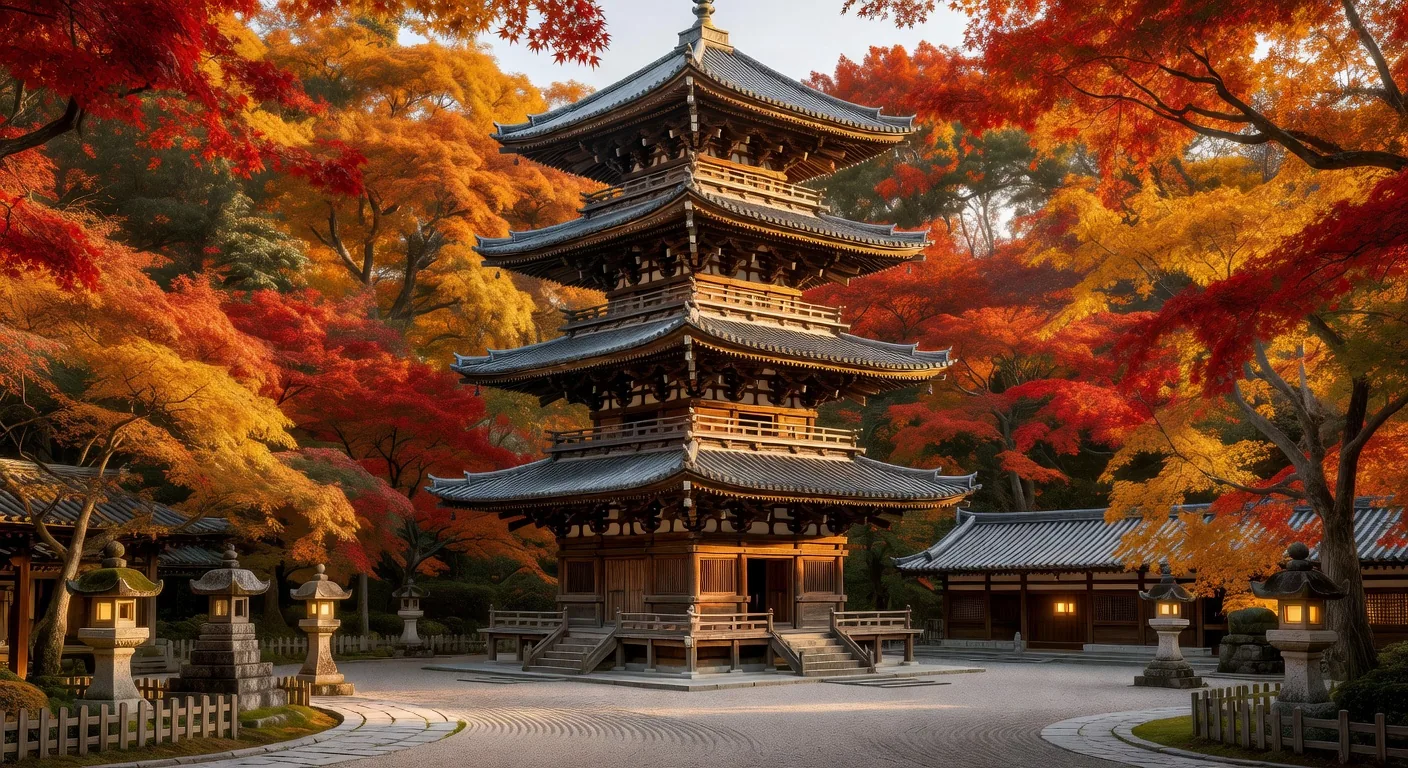
Pagoda amid autumn foliage in Kyoto

Kyoto 京都

Japan's imperial capital for more than a thousand years, Kyoto preserves the most cohesive and extensive collection of traditional Japanese architecture on Earth. The city's grid plan, laid out in 794 CE following the Tang Chinese capital Chang'an, still orders the urban fabric today. Within this structure, seventeen UNESCO World Heritage sites anchor a landscape of extraordinary cultural density: over 1,600 Buddhist temples, 400 Shinto shrines, and countless preserved machiya townhouses whose façades of dark cedar and latticed bamboo give Kyoto's older districts their distinctive rhythm.

What sets Kyoto's architecture apart is not mere antiquity but the living relationship between buildings and their settings. Temple gardens function as integral architectural elements — compressed landscapes that manipulate space, light, and time in the same way a master architect manipulates a floor plan.

Architectural Highlights

  • Kinkaku-ji's gold-leafed upper pavilions demonstrate the Muromachi period's synthesis of shinden and Zen aesthetics
  • Fushimi Inari's 10,000 vermilion torii gates create one of architecture's most immersive spatial sequences
  • The Katsura Imperial Villa is regarded as the founding text of Japanese modernism — influential for Le Corbusier, Walter Gropius, and Bruno Taut
  • Nijo Castle's uguisubari (nightingale floors) demonstrate how Edo-period architecture integrated security technology into building fabric
Must-See Buildings
  • Kinkaku-ji (Golden Pavilion) — 14th century
  • Katsura Imperial Villa — 17th century
  • Ryoan-ji Temple and rock garden
  • Nijo Castle — Edo-period palace complex
  • Fushimi Inari Taisha — 8th century
  • Tofuku-ji — Kamakura-period Zen complex
  • Kyoto Station — Hiroshi Hara (1997)
Best Districts for Architecture
  • Higashiyama — preserved temple-lined mountain path
  • Gion — geisha district with intact machiya streetscape
  • Arashiyama — mountain temples and bamboo groves
  • Nishijin — traditional weaving district townhouses
  • Fushimi — shrine and sake brewery architecture

Osaka 大阪

Japan's third-largest city and its historical commercial heartland, Osaka has always favored pragmatism and energy over the ceremonial restraint of Kyoto or the corporate precision of Tokyo. This character infuses its architecture with a refreshing directness: Osaka Castle's massive stone ramparts built on a scale designed to project absolute power, the cantilevered glass wings of the Umeda Sky Building piercing 173 meters into the Osaka sky, and the neon-drenched commercial streetscapes of Dotonbori that reduce architecture to pure spectacle.

Modern Osaka has attracted some of the world's most significant architectural commissions. Tadao Ando — born and based in Osaka — has profoundly shaped the city with his meditative concrete architecture, most visibly in the Church of the Light and the Museum of History.

Architectural Highlights

  • Osaka Castle's 1586 fortification represents the apex of Azuchi-Momoyama period defensive architecture
  • Umeda Sky Building's connected twin towers with rooftop Floating Garden Observatory remain an engineering landmark
  • Shinsekai district preserves a rare intact Taisho-era entertainment district streetscape
  • The National Museum of Art Osaka places its entire programme underground — only a steel sculpture marks its presence above ground
Must-See Buildings
  • Osaka Castle — Toyotomi Hideyoshi (1586)
  • Umeda Sky Building — Hiroshi Hara (1993)
  • Church of the Light — Tadao Ando (1989)
  • National Museum of Art — Cesar Pelli (2004)
  • Nakanoshima Festival Hall — Togo Murano (1958)
  • Expo '70 Commemorative Park structures
Best Districts for Architecture
  • Nakanoshima — island of civic and cultural institutions
  • Shinsekai — preserved 1920s entertainment district
  • Umeda — contemporary commercial tower district
  • Osaka-jo Park — castle and modern museum precinct
  • Minami / Shinsaibashi — layered commercial streetscapes

Nara 奈良

Japan's first permanent capital (710–784 CE), Nara contains the oldest surviving wooden structures in the world and the oldest wooden building on Earth — the West Main Hall of Horyuji Temple, constructed around 607 CE. The city's ancient urban core, Nara-machi, preserves a network of interconnected machiya townhouses from the Edo period alongside these earlier monuments, offering an unparalleled chronological survey of Japanese architectural development over fourteen centuries.

The Great Buddha Hall at Todai-ji, rebuilt in 1709 following fire, remains the world's largest wooden building — though only two-thirds the size of the original Tang-inspired structure. Its sheer scale, achieved without steel or concrete, continues to astonish engineers as much as tourists.

Architectural Highlights

  • Horyuji's West Main Hall (c.607 CE) is the oldest surviving wooden structure on Earth
  • Todai-ji's Great Buddha Hall (rebuilt 1709) is the world's largest wooden building by floor area
  • Kasuga Taisha's covered walkways demonstrate how Shinto shrine architecture mediates between sacred and natural realms
  • The 1998 Nara Centennial Hall by Arata Isozaki references the city's temple forms in contemporary abstract language
Must-See Buildings
  • Horyuji Temple complex — c.607 CE
  • Todai-ji Great Buddha Hall — 1709 (original 728 CE)
  • Kasuga Taisha Shrine — 768 CE
  • Kofuku-ji Five-Story Pagoda — 1426
  • Nara Centennial Hall — Arata Isozaki (1998)
Best Districts for Architecture
  • Nara-machi — Edo-period merchant townhouse district
  • Naramachi Koshi-no-ie — merchant house museum
  • Nara Park — ancient temple and shrine precinct
  • Sanjodori Street — traditional craft and townhouse corridor

Hiroshima 広島

Hiroshima presents perhaps the most powerful architectural narrative of any Japanese city: a near-total destruction in August 1945 followed by an extraordinary act of urban reconstruction that became a model for postwar city-building. The Atomic Bomb Dome — the only structure left standing near the bomb's hypocenter — now anchors a city of thoughtful civic spaces, memorial architecture, and contemporary buildings that engage honestly with their context of loss and renewal.

Kenzo Tange's Peace Memorial Park (1954) remains his greatest urban achievement, establishing a processional axis from the Ohta River to the Dome and creating a new form of memorial urbanism that influenced sites from Washington D.C. to Berlin. Hiroshima today is a city that has turned the act of rebuilding into a form of cultural expression.

Architectural Highlights

  • The Atomic Bomb Dome (Genbaku Dome) stands as the world's most significant memorial ruin and a UNESCO World Heritage Site
  • Kenzo Tange's Peace Memorial Park (1954) established a new grammar for memorial landscape architecture globally
  • Itsukushima Shrine on Miyajima Island demonstrates the Heian-period mastery of tidal and coastal building conditions
  • The Hiroshima City Naka Ward Office (1990) integrates deliberate historical references into its modernist frame
Must-See Buildings
  • Atomic Bomb Dome — Hiroshi Setsu (1915)
  • Peace Memorial Museum — Kenzo Tange (1955)
  • Peace Memorial Hall for Atomic Bomb Victims — Kisho Kurokawa (2002)
  • Itsukushima Shrine — Miyajima Island (593 CE)
  • Hiroshima Museum of Art — 1978
Best Districts for Architecture
  • Peace Memorial Park and surrounds — memorial precinct
  • Miyajima Island — shrine, pagoda and tidal architecture
  • Ujina — port and postwar reconstruction area
  • Hondori — postwar commercial main street

Kamakura 鎌倉

Japan's feudal capital from 1185 to 1333, Kamakura sits nestled between forested hills and Sagami Bay, 50 kilometres south of Tokyo. The city's Zen temples, warrior-class shrines, and the magnificent open-air Great Buddha (Kotoku-in) form a coherent architectural landscape that feels entirely distinct from the imperial traditions of Kyoto or the commercial energy of Osaka. Kamakura's architecture is the architecture of the warrior class — austere, direct, attuned to the natural landscape.

The Engaku-ji and Kencho-ji temple complexes preserve the most authentic examples of Zen temple planning (karesansui garden, karamon gate, sanmon entrance hall) in Japan, and have served as templates for Zen establishments worldwide since the 13th century.

Architectural Highlights

  • Engaku-ji represents the complete Gozan (Five Mountain) Zen temple planning system at its most intact
  • The Great Buddha of Kotoku-in has sat in the open air since its temple hall was swept away by tsunami in 1334
  • Tsurugaoka Hachimangu's elevated haiden (worship hall) commands the entire urban axis of old Kamakura
  • The narrow mountain paths (kamakura-michi) connecting temples are themselves cultural landscape architecture
Must-See Buildings
  • Kotoku-in Great Buddha — 1252
  • Tsurugaoka Hachimangu Shrine — rebuilt 1828
  • Engaku-ji Temple complex — 1282
  • Kencho-ji Temple — 1253
  • Hokoku-ji Temple — 1334 (bamboo garden)
Best Districts for Architecture
  • Kita-Kamakura — Zen temple precinct approach
  • Central Kamakura — shrine and surrounding townscape
  • Hase — coastal temple and Great Buddha precinct
  • Zaimokuza — coastal residential area with older structures

Kanazawa 金沢

Kanazawa is the city that escaped the bombs. Spared from both the 1923 earthquake and World War II air raids, it preserves the most complete Edo-period urban fabric outside Kyoto — including two intact samurai districts, two geisha entertainment quarters, and a well-preserved castle precinct. The city's historic prosperity as a castle town under the Maeda clan — Japan's most powerful domain outside the Tokugawa shogunate — financed an architecture of sustained refinement: lacquerware-detailed interiors, cedar-sheathed facades, and garden walls of mud plaster and tile that define Kanazawa's visual character.

The 21st Century Museum of Contemporary Art by SANAA (2004) has since brought the city global architectural attention, placing Kanazawa at the intersection of historical preservation and contemporary ambition.

Architectural Highlights

  • Kenroku-en garden (considered one of Japan's three finest) demonstrates how garden design functions as architecture of the landscape
  • Higashi Chaya geisha district preserves an intact 1820s streetscape of latticed ochaya teahouses
  • SANAA's 21st Century Museum is a radical exercise in democratic public space — circular, transparent, free
  • Kanazawa Castle's reconstructed Hishi Yagura tower demonstrates modern historic reconstruction methods at their finest
Must-See Buildings
  • 21st Century Museum of Contemporary Art — SANAA (2004)
  • Kanazawa Castle — original 1583, reconstructed 2001
  • Kenroku-en Garden — completed c.1840
  • Higashi Chaya District ochaya — 1820s
  • Oyama Shrine — German-influenced gate (1875)
  • Nomura Samurai House — Edo period interior
Best Districts for Architecture
  • Higashi Chaya — best-preserved geisha district
  • Nagamachi — samurai residential quarter
  • Katamachi / Korinbo — modern civic precinct
  • Teramachi — temple district hillside

Nagoya 名古屋

The capital of Aichi Prefecture and Japan's fourth-largest city, Nagoya is above all a city of manufacture — home to Toyota and a web of precision engineering industries that have shaped its modern architecture as much as any cultural or governmental force. Yet beneath the city's industrial modernity lies an extraordinary castle, the largest surviving collection of Edo-period fortification architecture in Japan, and a suburban sprawl punctuated by some of the country's most significant modern religious and civic buildings.

Nagoya Castle's restored Honmaru Palace — completed after a fifty-year reconstruction effort — provides the most detailed and research-led recreation of a senior daimyo's residential interiors available anywhere in Japan, with gilded sliding screens (fusuma) and lacquered coffered ceilings restored to their 1615 specifications.

Architectural Highlights

  • Nagoya Castle's paired golden shachihoko dolphins are the city's most recognized architectural detail, dating to 1612
  • The Atsuta Jingu shrine precinct covers 19 hectares and includes the country's second-most sacred Shinto site
  • Toyota Commemorative Museum of Industry and Technology occupies an intact early 20th-century industrial building complex
  • Aichi Arts Center (1992) represents the high point of Japanese postmodern civic architecture
Must-See Buildings
  • Nagoya Castle and Honmaru Palace — 1612/reconstructed 2018
  • Atsuta Jingu Shrine — 1st century CE
  • Aichi Arts Center — Kisho Kurokawa (1992)
  • Toyota Commemorative Museum — 1994
  • Nagoya City Hall — 1933 (Imperial Crown style)
  • Nagoya TV Tower — Tachu Naito (1954)
Best Districts for Architecture
  • Marunouchi — civic and government precinct
  • Atsuta — ancient shrine and surrounding gardens
  • Sakae — postwar commercial and cultural centre
  • Noritake Garden — industrial heritage precinct

Architecture Walking Tours

Self-guided walking routes through the most architecturally significant urban sequences in Japan. Each tour is designed to take approximately three to four hours at an unhurried pace.

Tokyo

Tokyo Modern Walk

3.8 km 3–4 hours Moderate

A traverse through Tokyo's most concentrated layer of significant 20th- and 21st-century architecture, from the wood-latticed interiors of Kengo Kuma's Nezu Museum to the soaring steel suspension of Kenzo Tange's 1964 National Gymnasium.

  1. Omotesando Hills — Tadao Ando (2006)
  2. Prada Aoyama — Herzog & de Meuron (2003)
  3. Nezu Museum — Kengo Kuma (2009)
  4. Spiral Building — Fumihiko Maki (1985)
  5. National Gymnasium — Kenzo Tange (1964)
  6. Tokyo Metropolitan Government Building — Kenzo Tange (1991)
Kyoto

Kyoto Temple Trail

5.2 km 4–5 hours Easy

The Higashiyama mountain-path walk is Japan's finest urban architectural promenade — a continuous thread of stone-paved lanes connecting temple gardens, shrine gates, and preserved machiya streetscapes beneath the eastern hills.

  1. Fushimi Inari Taisha — vermilion torii tunnel
  2. Tofuku-ji — Kamakura Zen complex and garden
  3. Kenninji — Kyoto's oldest Zen temple (1202)
  4. Yasaka Pagoda — iconic five-story landmark
  5. Kiyomizu-dera — cantilevered wooden stage platform
  6. Chion-in — largest sanmon gate in Japan (1621)
Osaka

Osaka Castle District

4.1 km 3–4 hours Easy

A walk through Osaka's oldest architectural layers, from the monumental stone ramparts of the 16th-century castle to the Meiji-era brick warehouses of Tenmabashi and the civic buildings of Nakanoshima island.

  1. Osaka Castle — stone ramparts and main tower (1586/1931)
  2. Osaka Museum of History — Nikken Sekkei (2001)
  3. NHK Osaka Broadcasting Center
  4. Nakanoshima Festival Hall — Togo Murano (1958)
  5. Osaka City Hall — Neo-Renaissance (1921)
  6. Nakanoshima Museum of Art — Endo Architect (2022)

Planning Your Visit

Architecture tourism in Japan rewards careful timing and preparation. The following information will help you make the most of each architectural encounter.

Best Seasons to Visit

Spring (late March to early May) and autumn (mid-October to late November) offer the most photogenic conditions: cherry blossom against temple rooflines in spring, and crimson maple against pagoda silhouettes in autumn. Summer offers long days for extensive walks but high humidity makes prolonged outdoor exploration demanding. Winter brings low visitor numbers and frost on temple rooftops — particularly atmospheric in Kyoto and Kanazawa.

Photography Guidelines

  • Interior photography is prohibited at most historic temples and shrines — always check posted signage
  • The golden hour before sunset creates optimal raking light for timber façades and garden compositions
  • Dawn visits to Fushimi Inari and Kinkaku-ji avoid crowds and produce dramatically different atmospheres
  • A 24–70mm equivalent lens covers most architectural subjects; a tilt-shift lens eliminates converging verticals
  • Tripods require special permits at many designated cultural properties

Opening Hours Note

  • Most temple and shrine complexes open at 8:00 or 9:00 and close at 17:00–17:30
  • National museums are typically closed on Mondays (or Tuesday if Monday is a national holiday)
  • Katsura Imperial Villa and Shugakuin require advance reservation through the Imperial Household Agency
  • Some Zen temple gardens open specially for the autumn and spring maple/cherry seasons with extended evening hours
  • Contemporary architecture (museums, civic buildings) generally follows standard business hours with Monday closures

Access & Transport

  • The JR Pass provides excellent coverage for intercity travel between all guide cities
  • Kyoto and Nara are best explored on foot or by bicycle; car rental is counterproductive in these cities
  • Tokyo's subway system reaches virtually every significant architectural landmark
  • Kamakura is a 50-minute express train from Tokyo's Ofuna or Yokohama stations
  • IC cards (Suica or ICOCA) work seamlessly across all urban transit systems